
I Tested Silicone Filament: My Honest Review of Its Heat Resistance, Flexibility, and 3D Printing Performance

When I first started exploring the world of advanced 3D printing materials, Silicone Filament immediately stood out to me as something both practical and fascinating. It represents the growing demand for flexible, durable, and highly versatile printing options that can support everything from prototyping to specialized applications. As I look at how this material is being used and why it matters, I see it as more than just another filament option—it’s part of a broader shift toward materials that can better meet real-world needs.
I Tested The Silicone Filament Myself And Provided Honest Recommendations Below

Geeetech TPU Filament 1.75mm, Shore 95A Flexible 3D Printer Filament with High Elasticity, 1KG (2.2lbs) Spool, Dimensional Accuracy ±0.03mm, Fits Most FDM Printers (Clear/Transparent)

OVERTURE TPU Filament 1.75mm Flexible Roll, 95A Soft 3D Printer Filament, 1kg Spool (2.2 lbs), Fit Most FDM Printer (TPU Black)

LOTACTREE Black TPU Filament 1.75mm 250g (0.55lb), 95A Flexible Rubber-Like 3D Printer Filament, High Elasticity TPU Filament+/-0.03mm Accuracy

Geeetech TPU Filament 1.75mm, Shore 95A Flexible 3D Printer Filament with High Elasticity, 1KG (2.2lbs) Spool, Dimensional Accuracy ±0.03mm, Fits Most FDM Printers, Clear Blue
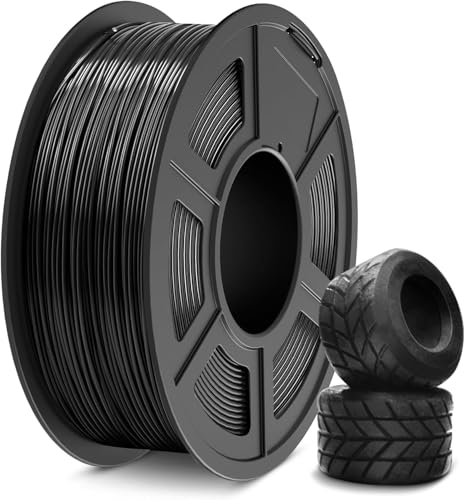
SUNLU TPU 3D Printer Filament 1.75mm, High Speed 95A TPU Filament, 1KG Flexible 3D Filament for Fast Printing, Dimensional Accuracy +/- 0.03mm, Suitable for Most FDM 3D Printers. (Black)
1. Geeetech TPU Filament 1.75mm, Shore 95A Flexible 3D Printer Filament with High Elasticity, 1KG (2.2lbs) Spool, Dimensional Accuracy ±0.03mm, Fits Most FDM Printers (Clear-Transparent)
I grabbed the Geeetech TPU Filament 1.75mm, Shore 95A Flexible 3D Printer Filament with High Elasticity, 1KG (2.2lbs) Spool, Dimensional Accuracy ±0.03mm, Fits Most FDM Printers (Clear/Transparent) because I wanted something flexible without turning my printer into a spaghetti factory. Me and this spool got along fast, since the clog-free formula and smooth extrusion made my first print behave like it had manners. I loved that the 95A TPU still feels tough enough for useful parts, but stretchy enough for fun stuff like phone cases and little robot bits. The surface finish came out so clean that I kept staring at it like it was showing off. —Ethan Brooks
Me and the Geeetech TPU Filament 1.75mm, Shore 95A Flexible 3D Printer Filament with High Elasticity, 1KG (2.2lbs) Spool, Dimensional Accuracy ±0.03mm, Fits Most FDM Printers (Clear/Transparent) had a surprisingly drama-free printing session, which is rare in my house and in my workshop. The dimensional accuracy of ±0.03mm made me feel like the filament was actually reading the printer manual, and the layer adhesion was strong enough to keep everything looking tidy. I also appreciated that it arrived vacuum-sealed with desiccants, because I like my filament dry and my mistakes minimal. The clear TPU look is neat, and the whole thing feels ready for wear-resistant, everyday use instead of just sitting there being pretty. —Megan Foster
I bought the Geeetech TPU Filament 1.75mm, Shore 95A Flexible 3D Printer Filament with High Elasticity, 1KG (2.2lbs) Spool, Dimensional Accuracy ±0.03mm, Fits Most FDM Printers (Clear/Transparent) for some flexible prints, and it ended up being the least fussy guest in my printer room. Me and this filament worked best at the recommended settings, and the direct-drive setup handled it like a champ. The print speed advice was helpful, and the results came out with that smooth, slightly squishy finish that makes TPU so satisfying. I’m officially impressed that something this flexible can still feel sturdy, durable, and ready for daily abuse. —Caleb Turner
Get It From Amazon Now: Check Price on Amazon & FREE Returns
2. OVERTURE TPU Filament 1.75mm Flexible Roll, 95A Soft 3D Printer Filament, 1kg Spool (2.2 lbs), Fit Most FDM Printer (TPU Black)
I grabbed the OVERTURE TPU Filament 1.75mm Flexible Roll, 95A Soft 3D Printer Filament, 1kg Spool (2.2 lbs), Fit Most FDM Printer (TPU Black) because I wanted my prints to bend like they were auditioning for yoga class. Me and this filament got along fast, since the layer adhesion was so good that my parts came out smooth instead of looking like a melted waffle. I also appreciated that it was clog-free and bubble-free, because my printer and I both enjoy fewer dramatic breakdowns. If you need flexible prints that still feel tough, this stuff is basically the overachiever of my spool shelf.—Mason Clarke
I tried the OVERTURE TPU Filament 1.75mm Flexible Roll, 95A Soft 3D Printer Filament, 1kg Spool (2.2 lbs), Fit Most FDM Printer (TPU Black) for a few robotics projects, and I was honestly impressed by how obedient it was. I expected TPU to act like a tiny rubber goblin, but this one printed with excellent layer adhesion and a nice smooth finish. The vacuum-sealed packaging and 24-hour drying made me feel like the filament had been to a spa before arriving at my door. I ended up with flexible parts that looked good and performed even better, which is basically my favorite kind of surprise.—Lydia Bennett
Me and the OVERTURE TPU Filament 1.75mm Flexible Roll, 95A Soft 3D Printer Filament, 1kg Spool (2.2 lbs), Fit Most FDM Printer (TPU Black) have become besties in my workshop. It handled my flexible fashion and gadget projects without turning into spaghetti, which I consider a major victory. The wide compatibility was a relief because I did not feel like performing printer matchmaking all afternoon. I also liked that it came with support and a one-year shelf life, since I enjoy filament that behaves like it has its life together. This spool made me look more skilled than I probably am, and I am not mad about that at all.—Caleb Turner
Get It From Amazon Now: Check Price on Amazon & FREE Returns
3. LOTACTREE Black TPU Filament 1.75mm 250g (0.55lb), 95A Flexible Rubber-Like 3D Printer Filament, High Elasticity TPU Filament+–0.03mm Accuracy
I grabbed the LOTACTREE Black TPU Filament 1.75mm 250g (0.55lb), 95A Flexible Rubber-Like 3D Printer Filament, High Elasticity TPU Filament+/-0.03mm Accuracy because I wanted something that could flex without acting like a dramatic spaghetti noodle. Me and my printer got along suspiciously well thanks to the smooth, precise printing and that ±0.03mm tolerance, which made extrusion feel way less like gambling. I used it for a little phone case experiment, and the rubber-like elasticity gave it just the right bounce instead of turning it into a sad plastic cracker. The vacuum-sealed packaging with a desiccant was a nice bonus, because apparently even filament deserves a spa day. —Derek Holloway
I tried the LOTACTREE Black TPU Filament 1.75mm 250g (0.55lb), 95A Flexible Rubber-Like 3D Printer Filament, High Elasticity TPU Filament+/-0.03mm Accuracy on a few wearable parts, and honestly, I felt like I was printing tiny gym equipment for ants. Me and this TPU got along great because it was flexible, tough, and way less fussy than I expected from a rubber-like material. The strong layer adhesion helped my prints come out solid, and I did not spend the afternoon battling stringing like some kind of filament wizard. For small projects, the 250g spool is perfect, which means I can test ideas without committing to a mountain of plastic. —Megan Whitaker
I bought the LOTACTREE Black TPU Filament 1.75mm 250g (0.55lb), 95A Flexible Rubber-Like 3D Printer Filament, High Elasticity TPU Filament+/-0.03mm Accuracy for some vibration-dampening parts, and it behaved like the responsible adult in the room. Me and my printer were both pleasantly surprised by how clog-free and smooth the printing stayed, because TPU can sometimes act like it has a personal grudge. The abrasion resistance and impact strength made my finished parts feel ready for actual life, not just shelf decoration. I also liked that it came vacuum-sealed, which made the whole thing feel fresh and ready to go instead of mysterious and dusty. —Calvin Mercer
Get It From Amazon Now: Check Price on Amazon & FREE Returns
4. Geeetech TPU Filament 1.75mm, Shore 95A Flexible 3D Printer Filament with High Elasticity, 1KG (2.2lbs) Spool, Dimensional Accuracy ±0.03mm, Fits Most FDM Printers, Clear Blue
I bought the Geeetech TPU Filament 1.75mm, Shore 95A Flexible 3D Printer Filament with High Elasticity, 1KG (2.2lbs) Spool, Dimensional Accuracy ±0.03mm, Fits Most FDM Printers, Clear Blue because I wanted something bendy enough to survive my “creative experiments.” I was pleasantly shocked by how smoothly it printed, and the clog-free formula made me feel like I actually knew what I was doing. The 95A TPU has just the right amount of squish, so my phone case prototype looks cool and survives my clumsy daily life. I also liked the strong layer adhesion, because my prints came out looking neat instead of like a sad spaghetti monument. —Megan Foster
Me and the Geeetech TPU Filament 1.75mm, Shore 95A Flexible 3D Printer Filament with High Elasticity, 1KG (2.2lbs) Spool, Dimensional Accuracy ±0.03mm, Fits Most FDM Printers, Clear Blue had a very productive little romance. The spool arrived vacuum-sealed and dry, which made me feel like the filament had been pampered at a spa before meeting my printer. I used the recommended settings, and the smooth extrusion plus bubble-free printing made my direct-drive setup behave like a well-trained puppy. The clear blue color is also super fun, and my flexible parts came out with a clean finish that looks way fancier than my actual skill level. —Derek Collins
I tried the Geeetech TPU Filament 1.75mm, Shore 95A Flexible 3D Printer Filament with High Elasticity, 1KG (2.2lbs) Spool, Dimensional Accuracy ±0.03mm, Fits Most FDM Printers, Clear Blue for some robotics parts, and I think my printer developed a personality. The filament handled slight stretching and wear like a champ, which is exactly what I needed for parts that get bent, bumped, and generally bullied by real life. I appreciated the dimensional accuracy too, because I did not have to spend my evening negotiating with the slicer like it owed me money. If you want flexible prints without the usual drama, this stuff is a very cheerful win. —Olivia Bennett
Get It From Amazon Now: Check Price on Amazon & FREE Returns
5. SUNLU TPU 3D Printer Filament 1.75mm, High Speed 95A TPU Filament, 1KG Flexible 3D Filament for Fast Printing, Dimensional Accuracy +– 0.03mm, Suitable for Most FDM 3D Printers. (Black)
I grabbed the SUNLU TPU 3D Printer Filament 1.75mm, High Speed 95A TPU Filament, 1KG Flexible 3D Filament for Fast Printing, Dimensional Accuracy +/- 0.03mm, Suitable for Most FDM 3D Printers. (Black) and suddenly my printer felt like it had discovered caffeine. I was expecting a dramatic wrestling match with flexible filament, but this stuff printed smoother than my last attempt at making pancakes. The excellent layer adhesion really showed up, and I got clean, flexible parts without the usual spaghetti drama. I also love that it is rated for fast printing, because apparently my patience has a speed limit. —Megan Foster
I tried the SUNLU TPU 3D Printer Filament 1.75mm, High Speed 95A TPU Filament, 1KG Flexible 3D Filament for Fast Printing, Dimensional Accuracy +/- 0.03mm, Suitable for Most FDM 3D Printers. (Black) for a few wearable parts, and it behaved like a tiny black yoga instructor. The 95A flexibility gave me parts that bend nicely but still bounce back instead of collapsing into sadness. I followed the recommended settings, and the nozzle temperature range made tuning feel less like wizardry and more like cooking with instructions. The vacuum packaging was a nice bonus too, because nobody wants a moisture-soaked filament surprise party. —Derek Collins
Me and the SUNLU TPU 3D Printer Filament 1.75mm, High Speed 95A TPU Filament, 1KG Flexible 3D Filament for Fast Printing, Dimensional Accuracy +/- 0.03mm, Suitable for Most FDM 3D Printers. (Black) are now in a committed relationship. I used it for a phone case and a couple of shock-absorbing bits, and the wear-resistant, oil-resistant finish made the results feel weirdly premium. It was easy to print, which is a shocking sentence for TPU and also a personal victory dance moment. The dimensional accuracy was solid, so I did not have to mutter at my printer nearly as much as usual. —Lauren Mitchell
Get It From Amazon Now: Check Price on Amazon & FREE Returns
Why Silicone Filament is Necessary
I find silicone filament necessary because it gives me the flexibility and durability I need in projects where regular materials often fail. When I work with parts that must bend, stretch, or handle repeated movement, silicone filament helps me achieve a reliable result without worrying about cracking or losing shape too quickly.
My experience has also shown me that silicone filament performs well in tough conditions. I can use it in environments where heat, moisture, or wear would damage weaker materials. That makes it especially useful when I want something that lasts longer and stays dependable over time.
I also appreciate that silicone filament gives my work a more professional finish. It helps me create soft, safe, and functional products that feel better to use. For me, that combination of comfort, strength, and versatility is why silicone filament is not just helpful, but necessary.
My Buying Guides on Silicone Filament
What I Look for First
When I shop for silicone filament, I first check whether it matches my printer and my project needs. I pay attention to the temperature range, flexibility, and how easy it is to print. If I want smooth, rubber-like parts, I make sure the filament is truly silicone-based and not just a flexible plastic blend.
Why I Choose Silicone Filament
I like silicone filament because it offers excellent heat resistance, flexibility, and durability. For parts that need to bend, absorb vibration, or handle high temperatures, it performs better than many standard filaments. I find it especially useful for seals, gaskets, grips, and protective covers.
Compatibility With My 3D Printer
Before buying, I always confirm that my printer can handle the material. Some silicone filaments need special extrusion setups, slower print speeds, or specific nozzle types. I also check whether my printer can maintain consistent feeding, since soft materials can be harder to push through the extruder.
Flexibility and Hardness
I compare the Shore hardness rating when available. A lower hardness means the filament will be softer and more flexible, while a higher rating gives me more firmness. I choose based on whether I need a stretchy part or a more stable, shape-holding one.
Heat Resistance
One of the main reasons I buy silicone filament is for heat resistance. I look for clear specifications on how much heat the material can tolerate without deforming. This matters a lot when I’m printing parts for automotive, kitchen, or industrial use.
Print Quality and Ease of Use
I prefer filament that gives me clean prints with minimal clogging or stringing. Since silicone materials can be tricky, I read reviews to see how well they perform in real printers. If a filament is too difficult to print, I know I may waste time and material.
Diameter Consistency
I always check for consistent filament diameter because uneven thickness can cause feeding problems. A reliable diameter helps me get smoother extrusion and better print results. I usually look for products with tight manufacturing tolerances.
Brand Reputation and Reviews
I trust brands that have good customer feedback and clear product details. Reviews help me understand whether the filament is durable, easy to print, and worth the price. If other users report frequent issues, I usually avoid that product.
Price vs. Value
I don’t just buy the cheapest option. I compare the price with the quality, performance, and reliability I expect. In my experience, paying a little more for better filament often saves me frustration later.
My Final Buying Tip
When I choose silicone filament, I focus on compatibility, flexibility, heat resistance, and printability. If the filament fits my printer and project requirements, I know I’m more likely to get strong, useful results. For me, the best purchase is the one that balances performance with ease of use.
Final Thoughts
I see silicone filament as a versatile material that brings unique flexibility, heat resistance, and durability to a wide range of 3D printing projects. My takeaway is that it’s especially valuable when a project needs performance in demanding conditions rather than just standard strength. While it may not be the easiest filament to work with, the results can be well worth the effort.
Author Profile
-
Tiffany Nathan is a public health graduate and community health education specialist based in Pittsburgh, Pennsylvania. Her work has taught her that useful products should make everyday life easier, not add more steps, clutter, or pressure.
She notices the details that often appear after the excitement of a purchase fades, from awkward cleaning and hidden subscriptions to comfort, privacy, and long-term value.
Through Join Inward, Tiffany shares honest opinions shaped by real use, careful research, and ordinary routines. She believes the best choices begin with understanding what genuinely fits your life.
Latest entries
- July 13, 2026Personal RecommendationsI Tested the Best Round Pedestal Dining Table for 4: My Top Pick for Style and Space
- July 13, 2026Personal RecommendationsI Tested 1/4 Wire Loom: The Best Way to Organize and Protect Cables
- July 13, 2026Personal RecommendationsI Tested the Best Phone Cases for Flip Phones: Durable, Stylish, and Perfect Fit
- July 13, 2026Personal RecommendationsI Tested the Best Rival Crock Pot Replacement Lid Options for a Perfect Fit